

Duolingo: Language Lessons
The world’s most popular way to learn languages

Duolingo: The World’s Most Popular Language Learning App – Is It Really Effective?
For many aspiring language learners, the biggest challenge isn’t finding learning resources, but rather how to maintain consistency. The market is flooded with language courses, textbooks, and learning software, but few products truly help users maintain a long-term learning habit. Duolingo is one of the few language learning apps that has successfully achieved this.
With its easy and fun learning methods and rich language courses, Duolingo has attracted hundreds of millions of users worldwide. Whether you want to learn English, Spanish, French, or popular languages like Japanese and Korean, you can find corresponding courses within this app. So, what are Duolingo’s advantages? Can it truly help users improve their language skills? After using it for a while, I have a more comprehensive understanding of this software.

What is Duolingo?
Duolino is a mobile application centered on language learning. Its biggest feature is combining traditional learning content with gamification. Unlike many apps that emphasize systematic courses and complex theories, Duolingo focuses on allowing users to gradually accumulate language skills through short, frequent practice sessions.
| Feature | Details |
|---|---|
| App Name | Duolingo |
| Category | Language Learning App |
| Founded | 2011 |
| Founder | Luis von Ahn & Severin Hacker |
| Headquarters | Pittsburgh, Pennsylvania, USA |
| Available Platforms | iOS, Android, Web Browser |
| Languages Offered | 40+ Languages |
| Learning Methods | Reading, Listening, Speaking, Writing |
| Free Version | Yes |
| Premium Plan | Super Duolingo |
| Best For | Beginners and Casual Learners |
| Offline Learning | Available for Premium Users |
The entire course is broken down into numerous small units, each typically lasting only a few minutes. Users learn new knowledge through listening, reading, translation, spelling, and simple speaking exercises, while also earning rewards such as experience points and continuous learning records.
From its positioning, Duolingo is not a software specifically for exam preparation, but rather a tool to help users cultivate learning habits and build a language foundation.
What Languages Can You Learn on Duolingo?
One of Duolingo’s biggest advantages is its wide selection of language courses. Whether you want to learn a global language for work and travel or explore a less common language for personal interest, there is a good chance Duolingo offers a course for it.
Some of the most popular languages available on Duolingo include:Spanish,French,German,Italian,Portuguese,Japanese,Korean,Chinese (Mandarin),English,Russian.
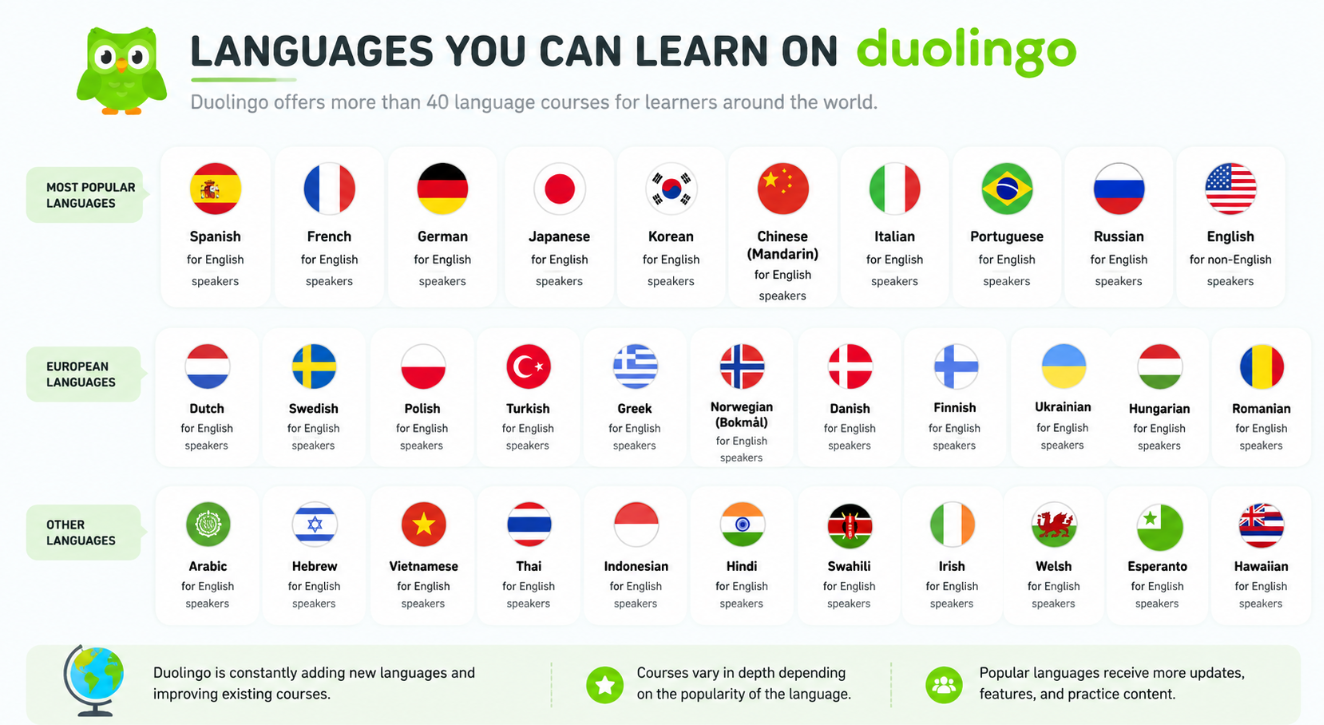
Beyond these major languages, Duolingo also offers courses in languages such as Dutch, Swedish, Norwegian, Polish, Turkish, Greek, Ukrainian, Hebrew, Irish, Welsh, Hawaiian, Esperanto, and several others.
Is the Quality the Same for Every Language?
Not exactly. Popular courses such as Spanish, French, German, Japanese, and English generally receive the most updates, learning content, speaking exercises, and new features. These courses tend to offer the best overall learning experience.
Smaller courses, especially those for less commonly studied languages, may have fewer lessons, less advanced content, and limited speaking practice. They are still useful for beginners but may not provide the same depth as Duolingo’s flagship courses.
If you’re learning a major language like Spanish, French, German, Japanese, Korean, or English, Duolingo offers one of the strongest free learning experiences available. For niche languages, it works best as an introduction rather than a complete learning solution.
What’s the actual experience like?
The most noticeable impression upon first using Duolingo is its simplicity. After registration, the system asks for your learning goals and level, then automatically generates a learning path. The entire process requires almost no additional setup, allowing even those completely new to language learning software to quickly begin their first lesson.
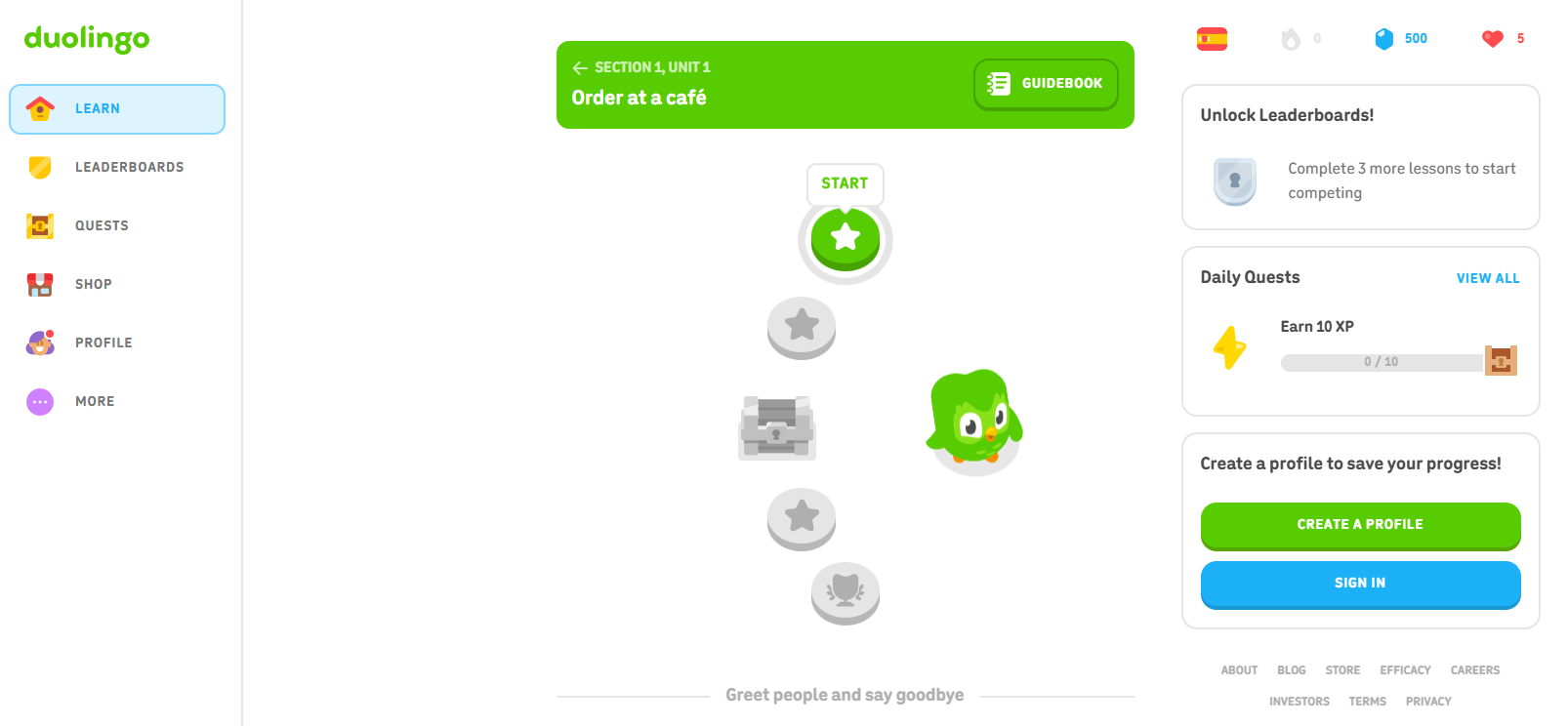
During the learning process, the course content is designed to be highly fragmented. Each exercise only takes a few minutes, avoiding excessive pressure and minimizing the time commitment. This learning pace is very friendly for busy individuals or those with heavy academic workloads.
Meanwhile, Duolingo continuously encourages users to persist in their learning through mechanisms such as experience points, leaderboards, and continuous check-ins. While these features may seem more like game elements, they genuinely enhance learning motivation. Compared to many learning apps that are easily forgotten, Duolingo excels at cultivating learning habits.
What are the Duolingo’s advantages & shortcomings?
#Advantages:
Among numerous language learning apps, Duolingo’s most obvious advantage is its low learning threshold.
Many people give up learning a foreign language not because the content is too difficult, but because the initial learning process is too complex. Duolingo solves this problem effectively. It doesn’t confront users with lengthy course catalogs and complex grammar explanations, but instead guides them step-by-step through new knowledge.
Furthermore, the software’s engaging nature is a crucial reason for its success. Traditional learning often feels tedious and stressful, while Duolingo makes the learning process much easier through gamification. Instant feedback is provided for each small goal achieved, and this sense of accomplishment effectively boosts users’ continued motivation.
Duolingo also performs well in learning basic vocabulary and common expressions. Repetitive exercises within the lessons help users memorize high-frequency words and gradually build familiarity with the target language. For learners with no prior knowledge, this approach is often easier to grasp than directly reading textbooks.
Furthermore, Duolingo supports a wide range of languages. Whether it’s mainstream languages or some less common ones, there are corresponding courses available, a feat many similar products struggle to achieve.
#Shortcomings:
While Duolingo has many advantages, it’s not without its flaws. The most obvious problem is the limited depth of its courses.
For beginners, Duolingo offers a rich enough content, but as learning progresses, some limitations become apparent. For example, grammar explanations are relatively simple, and many concepts rely more on users summarizing through practice rather than systematic learning.
If your goal is to take language exams, conduct business communication, or reach a high level of language proficiency, relying solely on Duolingo is often insufficient. Compared to professional courses and systematic textbooks, it still lags significantly in advanced grammar, writing skills, and complex expression training.
Additionally, while the app offers speaking and listening practice functions, these exercises are mostly based on pre-set content. The speed, expression, and contextual changes in real-world language environments are far more complex than in courses. Therefore, Duolingo is more suitable as a supplementary training tool and cannot completely replace real-world communication practice.
For some free users, advertising is also a factor affecting the experience. However, considering the large amount of free learning content offered by the software itself, this is still within an acceptable range.
Who is Duolingo suitable for?
From an overall experience perspective, Duolingo is most suitable for users who are new to language learning.
If you have absolutely no experience with a language and want an easy way to get started, Duolingo is a good choice. It can help you master basic vocabulary and common expressions and gradually build learning habits.
For people who are busy with work and don’t have large blocks of time for study, Duolingo is also attractive. Completing a few short lessons in ten minutes a day can maintain a continuous learning state without the need for a complicated study plan.
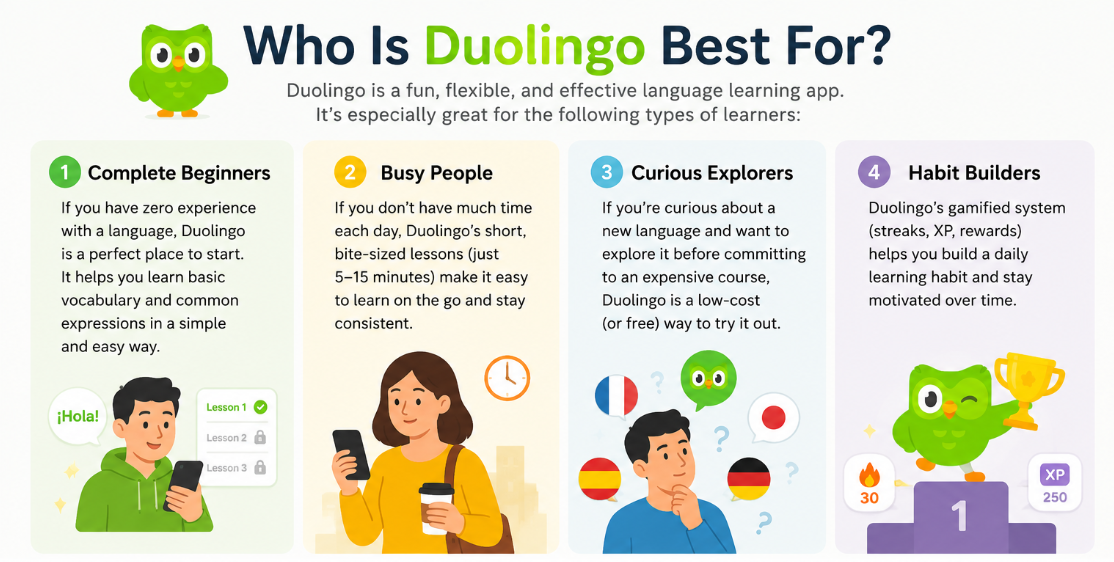
Furthermore, if you are interested in a language and want to try it out first without immediately investing in expensive courses, Duolingo is also a low-cost or even free option.
However, for learners preparing for exams like IELTS, TOEFL, TOPIK, and JLPT, Duolingo is more suitable as a supplementary tool than a primary learning channel. The systematic knowledge and advanced skills required for these exams still need to be acquired through textbooks, courses, and extensive practical practice.
Final Evaluation
Overall, Duolingo isn’t software that allows users to quickly master a foreign language, but it is indeed a product that can help more people start learning and stick with it.
Its greatest value lies not in teaching complex language knowledge, but in lowering the learning threshold and making language learning easier and more fun. For beginners, hobbyists, and those with limited time, Duolingo is undoubtedly one of the most worthwhile language learning apps on the market.
If your goal is to cultivate learning habits, build a basic vocabulary, and gradually develop language skills, then Duolingo is worth downloading and trying; if your goal is to reach an advanced language level or prepare for professional exams, it is recommended to use it as a supplementary tool in conjunction with other learning resources.
Download Now:


Have you used Duolingo to learn a language? Share your experience in the comments. Your feedback can help other learners!