
Snapchat
Download to try the most popular Lenses, Snap and Chat with friends, explore the Map, and so much more!
Snapchat Review (2026): A Comprehensive Look at the Camera-First Social Platform
What Is Snapchat?
Snapchat is a multimedia messaging platform developed by Snap Inc., the technology company co-founded in 2011 by Evan Spiegel, Bobby Murphy, and Reggie Brown while they were students at Stanford University. Unlike traditional social networks that prioritize permanent profiles and public engagement, Snap has consistently described itself as a “Camera Company.” This positioning reflects its belief that the smartphone camera should be the primary interface for communication rather than a tool used only to capture content.
Instead of encouraging users to build permanent public identities, Snapchat was designed around quick visual conversations. Photos and videos are created first, then shared instantly with friends through private messages, Stories, or group chats. This camera-first philosophy has influenced many features later adopted across the social media industry.
Over the years, Snapchat has introduced several innovations that have reshaped digital communication.
| Core Innovation | Description | Industry Impact |
|---|---|---|
| Ephemeral Messaging | Messages and Snaps disappear after viewing unless saved. | Shifted focus from permanent social timelines to private communication. |
| Stories | Photos and videos remain visible for 24 hours. | Widely adopted by Instagram, Facebook, WhatsApp, and YouTube. |
| Snap Map | Interactive map showing friends’ locations (with permission). | Combined real-world location with social networking. |
Rather than competing solely as an entertainment platform, Snapchat positions itself somewhere between messaging, augmented reality, and visual communication. This unique combination has helped it maintain a loyal user base, particularly among younger audiences.
Core Features and Real User Experience
Unlike many social platforms that revolve around feeds and public posting, Snapchat feels more like an ongoing visual conversation. After spending time with the app, it becomes clear that almost every interaction begins with the camera.
Chat & Ephemeral Messaging
The messaging experience remains Snapchat’s foundation.
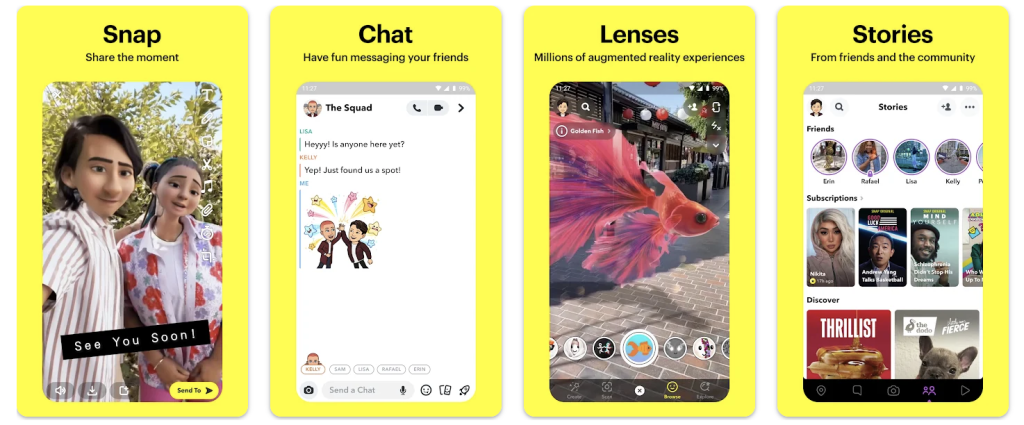
Opening the app immediately launches the camera instead of a content feed, encouraging users to send spontaneous photos or short videos rather than carefully edited posts. Messages automatically disappear after being viewed unless participants intentionally save them inside the chat.
This temporary design changes user behavior in subtle ways. Conversations often feel more casual because users generally don’t worry about creating content that will remain visible forever.
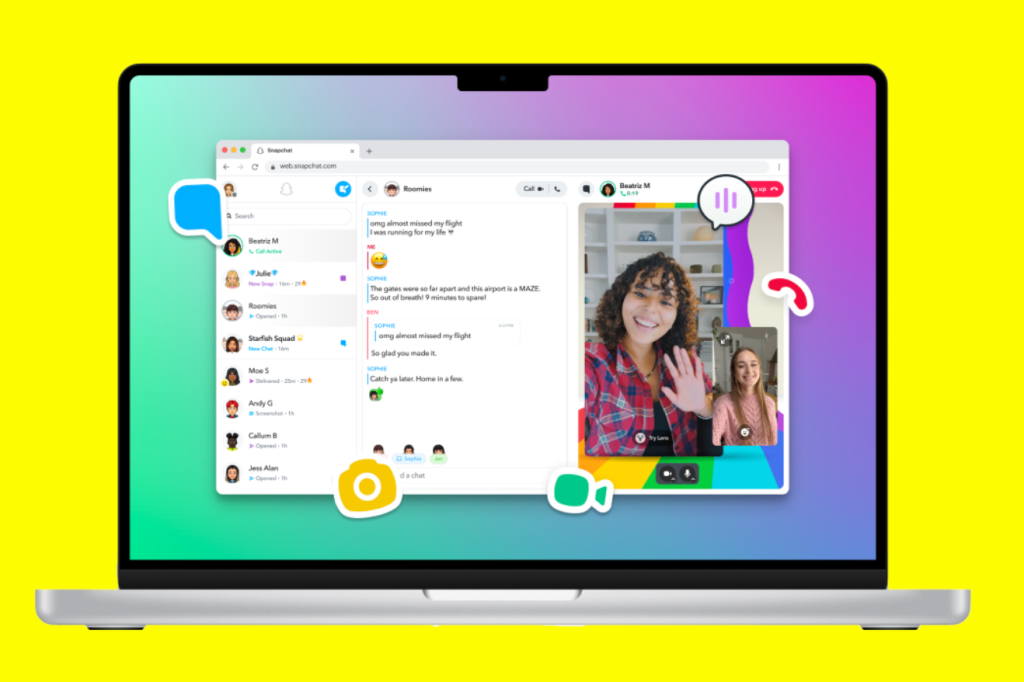
The platform also includes:
- Voice notes
- Video calls
- Group chats
- Reactions
- Bitmoji stickers
- Voice and video messages
For many users, Snapchat functions more like a close-friends messaging app than a traditional social network.
AR Lenses and the Camera-First Experience
Snapchat remains one of the industry’s leaders in consumer augmented reality.
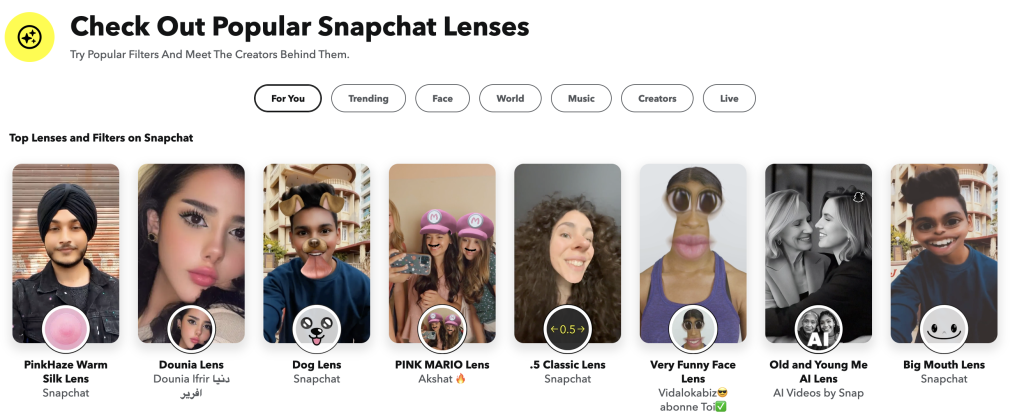
The application offers thousands of interactive AR Lenses that use facial recognition, body tracking, and machine learning to overlay digital effects in real time. These experiences range from humorous face filters to sophisticated virtual try-on tools for makeup, glasses, shoes, and fashion accessories.
What distinguishes Snapchat is that AR is integrated directly into everyday communication rather than existing as a separate feature.
The platform has also invested heavily in developer tools through Lens Studio, allowing creators and brands to publish custom AR experiences that reach millions of users.
Compared with many competing apps, Snapchat’s camera launches faster, and switching between recording, applying filters, and sending content requires very few steps.
Snap Map: Social Location Sharing
Snap Map introduces a different approach to location sharing.
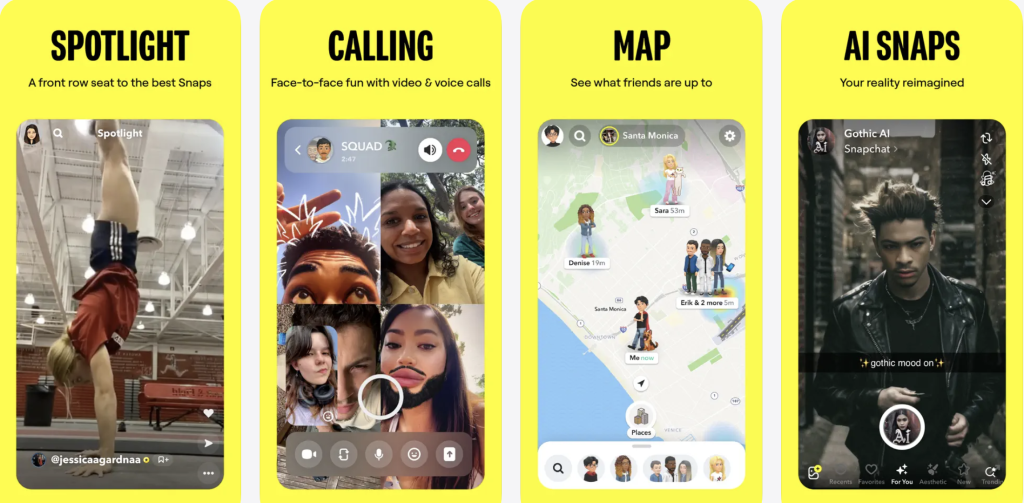
Users can voluntarily share their live location with selected friends, making it possible to see where trusted contacts are currently located. Privacy settings allow complete control over visibility, including the option to activate Ghost Mode, which hides a user’s location entirely.
Beyond friend locations, Snap Map also surfaces:
- Local events
- Trending public Stories
- Restaurants and popular venues
- Community content nearby
For younger users who frequently meet friends offline, the feature often feels more practical than traditional check-in systems. However, because location sharing naturally raises privacy concerns, Snapchat provides granular controls over who can view this information.
Discover and Spotlight
Snapchat is no longer limited to private communication.
The Discover section aggregates professionally produced content from publishers, media companies, sports organizations, creators, and entertainment brands. News, celebrity interviews, lifestyle videos, and educational content all appear here.
Meanwhile, Spotlight serves as Snapchat’s short-form video platform.
Its recommendation algorithm emphasizes entertainment and creativity rather than follower counts, giving smaller creators occasional opportunities for broader visibility. While Spotlight resembles TikTok in format, its creator ecosystem remains considerably smaller.
Because Snapchat’s identity is still centered around messaging, entertainment content generally complements rather than replaces private interactions.
Snapchat+, My AI, and Premium Features
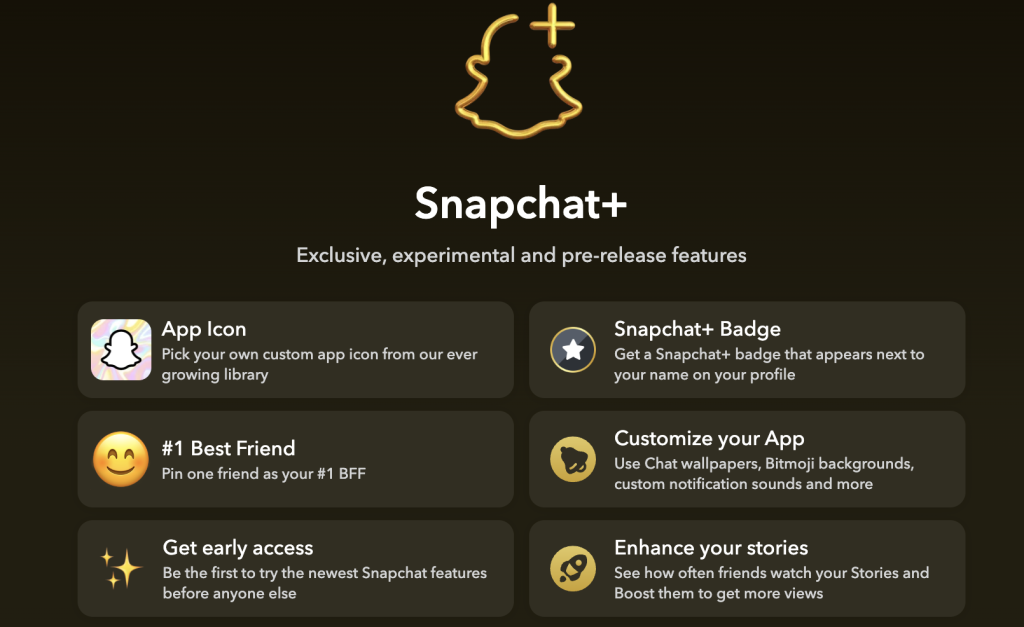
Snapchat introduced Snapchat+ as its premium subscription service, providing early access to experimental features alongside personalization options.
Subscribers gain access to features such as:
- Custom app icons
- Extended Story expiration options
- Friend interaction insights
- Priority support
- Exclusive cosmetic customization
One of the platform’s most visible additions is My AI, an AI-powered chatbot integrated directly into conversations. Built using OpenAI technology alongside Snap’s own product design, My AI can answer questions, recommend restaurants, brainstorm ideas, summarize information, and participate in casual conversations.
The integration feels relatively seamless because the assistant appears as another chat contact rather than a separate application.
Although My AI expands Snapchat’s functionality, many users still view it as a supplementary tool rather than the platform’s primary attraction.
User Base and Audience Profile
Snapchat remains one of the largest social communication platforms globally, particularly among younger demographics.
According to recent Snap Inc. reports, the platform now reaches hundreds of millions of daily active users, with global daily active users exceeding 900 million and continuing to grow across multiple international markets. North America remains Snapchat’s strongest revenue market, while India has become one of its fastest-growing user bases due to increased smartphone adoption and affordable mobile internet.
The platform’s audience differs noticeably from many competitors. Snapchat has exceptionally strong penetration among people aged 13 to 34, especially in the United States, Canada, the United Kingdom, Australia, and several European countries. In these regions, Snapchat is often used daily for private communication rather than public content creation.
This demographic profile makes Snapchat particularly attractive for brands targeting Generation Z and younger Millennials. At the same time, its user base is less evenly distributed across older age groups than platforms such as Facebook or WhatsApp.
Unlike networks that prioritize follower counts and public influence, Snapchat’s engagement is driven primarily by communication among existing friends. As a result, average usage often consists of frequent, short interactions throughout the day rather than extended browsing sessions.
Strengths and Limitations
| Pros ✅ | Cons ❌ |
|---|---|
| Reduces social pressure through disappearing conversations instead of permanent public posts. | Interface can feel confusing for first-time users because many gestures are hidden. |
| Industry-leading augmented reality experiences and camera technology. | Less suitable for building searchable long-term content libraries. |
| Strong engagement among close friends and private communities. | Creator discovery remains smaller than TikTok or Instagram. |
| Fast, intuitive camera interface designed for spontaneous sharing. | Public content ecosystem is relatively fragmented. |
| Flexible privacy controls for messaging and location sharing. | Marketing reach generally trails larger recommendation-based platforms. |
Overall, Snapchat’s strengths stem from its emphasis on private communication rather than public broadcasting. Users who value authentic interactions often appreciate the platform’s lower social pressure and camera-centric design.
Its limitations become more noticeable for creators and businesses seeking large-scale content distribution. Since most activity occurs in private conversations, content tends to have a shorter lifespan and lower long-term discoverability than on platforms built around searchable feeds and recommendations.
Privacy, Safety, and Ongoing Challenges
Privacy has always been central to Snapchat’s identity, but disappearing messages alone should not be mistaken for complete security. Recipients can still take screenshots or record screens, and Snapchat generally notifies users when screenshots are captured.
To provide stronger protection for sensitive content, Snapchat includes My Eyes Only, an encrypted section within Memories that requires an additional passcode. This allows users to separate private photos and videos from their standard saved content. Users can also lock access to the app using device authentication methods such as Face ID, fingerprint recognition, or a passcode where supported.
For families, Snapchat has expanded parental oversight through Family Center, which enables parents to view aspects of their teenagers’ friend networks and communication patterns without revealing the content of private conversations. The feature attempts to balance adolescent privacy with parental awareness, though its effectiveness depends on both participation and user understanding of available controls.
Despite these safeguards, Snapchat continues to face scrutiny from regulators and child-safety organizations. Concerns include the misuse of disappearing messages, exposure to inappropriate content, online exploitation, and challenges related to age verification. The company has responded by introducing stronger reporting systems, educational resources, safety partnerships, and expanded moderation efforts, but debates around youth protection remain ongoing.
Like many large social platforms, Snapchat must continually balance user privacy, product innovation, and regulatory expectations across different countries.
Final Thoughts
Snapchat occupies a distinctive position within the social media landscape. Rather than competing directly as a traditional content-sharing network, it emphasizes visual communication, augmented reality, and private interaction between friends. Features such as ephemeral messaging, Stories, Snap Map, and advanced AR experiences have influenced the broader industry while helping the platform retain a clear identity.
Its strongest appeal lies with younger users who value fast, informal communication over carefully curated public profiles. Businesses and creators can still benefit from Discover, Spotlight, and advertising products, but those seeking maximum organic reach may find larger recommendation-driven platforms more effective.
From an objective perspective, Snapchat is best understood as a communication platform first and a content platform second. Its long-term relevance depends not only on expanding entertainment features and AI capabilities but also on maintaining user trust through continued investment in privacy, safety, and responsible product design.
Is Snapchat Worth Downloading?
If you enjoy sharing everyday moments with close friends rather than posting everything publicly, Snapchat is well worth trying. Its disappearing messages, creative AR camera, and private-first design create a more relaxed social experience than many traditional social networks. While it may not be the best platform for building a public audience or discovering long-form content, it remains one of the strongest choices for visual messaging, casual communication, and interactive augmented reality features.
Whether you’re a student, a Gen Z user, someone who enjoys experimenting with camera effects, or simply looking for a different way to stay connected with friends, Snapchat offers a unique experience that stands apart from feed-driven social media. Since the app is free to download on both iOS and Android, it’s easy to explore its features and decide whether its communication style fits your daily social habits.
Download Here: